Jaw Vibrato Exercises
The most commonly used vibrato method for the saxophone is the jaw vibrato. In the jaw vibrato the lower jaw moves smoothly up and down on its hinges.This causes fluctuations of :
- the size and shape of the upper oral tract (mouth), and
- the pressure of the embouchure.
Until the late 1970s it was thought that the vibrato was exclusively the result of fluctuating embouchure pressure.In the 1980s the general opinion swung the other way towards the believe that the oral tract changes were fully responsible for the vibrato effect. I personally believe that both fluctuations contribute to the jaw vibrato.
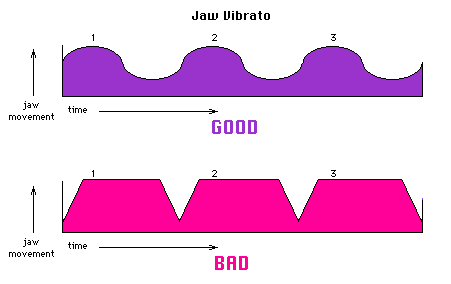
Fluctuate the lower jaw by voicing ”wawawawawawa” while maintaining the lips in the correct embouchure configuration.
Use a metronome for the following exercises
Exercise 1
Set the metronome at 35 (beats per minute)
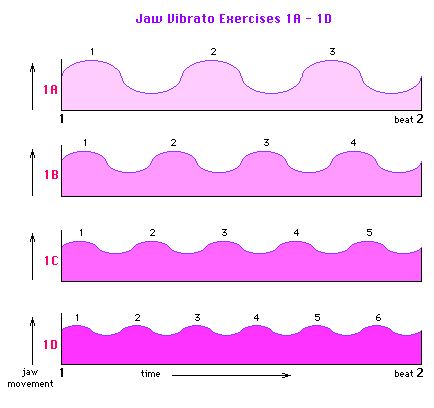
- Practice three fluctuations per beat: “wawawa”
- This is a very low frequency.
- Extend your jaw downwards as far as possible without losing the embouchure.
- Do not worry about the sound you produce. Just try to maintain a fluent motion of the jaw.
- Play each note of the G major scale (over 1 octave) this way, two beats for each note (“wawawawawawa”). Play the scale in ascending order.
- Practice four fluctuations per beat: “wawawawa”
- When you have reached the upper G of the G major scale in exercises 1A, descend in the same way, but now at a frequency of four waws per beat.
- Practice five fluctuations per beat: “wawawawawa”
- Ascend the G major scale again, each note for two beats (8 waws).
- If you have difficulty in playing 5 waws in a beat evenly, subdivide each 5 into a 3 and a 2.
- Practice six fluctuations per beat: “wawawawawawa”
- When you have reached the upper G of the G major scale in exercises 1C, descend in the same way, but now at a frequency of six waws per beat.
As you proceed through exercises 1A to 1D the amplitude (vertical jaw movement) decreases as the frequency (of waws) increases.
Exercise 2
Set the Metronome at 40 (beats per minute) Repeat the exercises 1A to 1D, but now at the higher Metronome tempo.
Exercise 3
Set the Metronome at 45 (beats per minute) Repeat the exercises 1A to 1D, but now at the higher Metronome tempo.
Exercise 4
Set the Metronome at 50 (beats per minute) Repeat the exercises 1A to 1D, but now at the higher Metronome tempo.
Exercise 5
Set the Metronome at 55 (beats per minute) Repeat the exercises 1A to 1D, but now at the higher Metronome tempo.
Exercise 6
Set the Metronome at 60 (beats per minute) Repeat the exercises 1A to 1D, but now at the higher Metronome tempo.
Exercises 5D and 6D (with six waws per beat) are moving outside the practical range for vibrato. You may attempt these as an extra challenge or omit them from you practice schedule as you wish.
Regular practice of these exercises for 5 - 10 minutes per day will start to produce a good vibrato action after about 12 months.